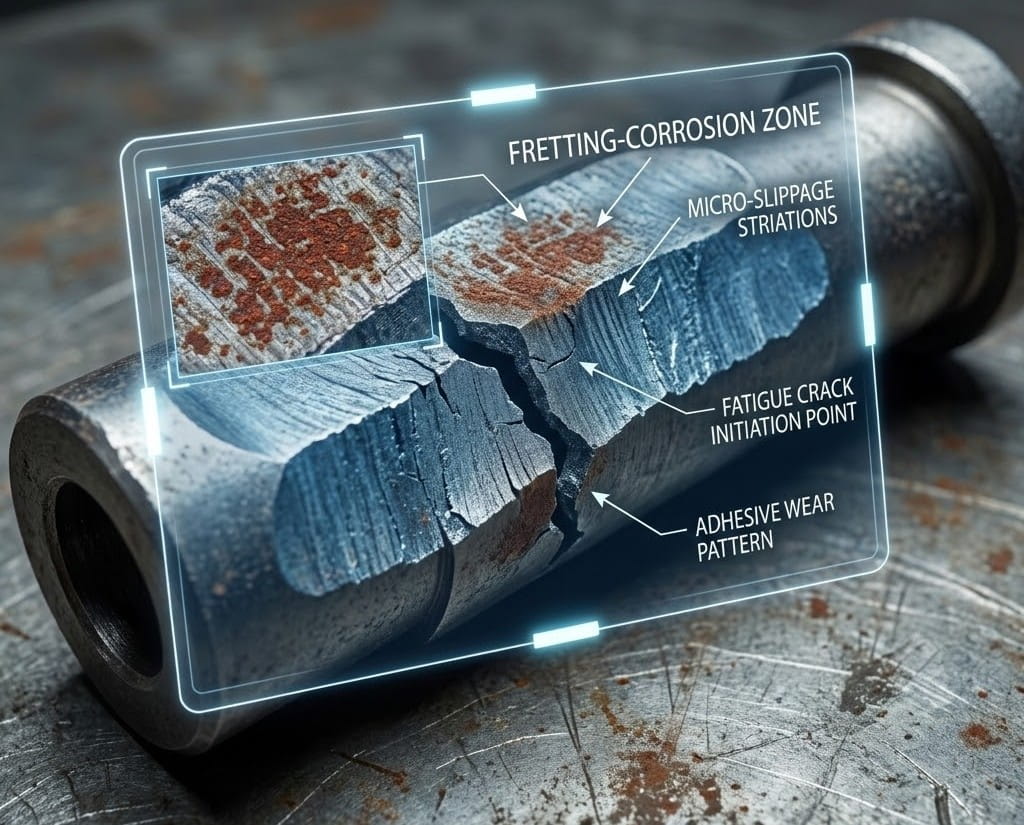
In the arena of maritime expertise, tribology is not a mere laboratory study; it is a formidable investigative instrument used to dissect the mechanics of an accident and extract irrefutable evidence. Where human testimony ends or falters, matter begins to speak.
1. A "Scanner" of Accident Kinetics
When handling equipment strikes a container, the expert sees more than just crumpled metal. He uses tribology as an instrument to read the memory of the metal. High-pressure contact surface analysis allows the scene to be defined with surgical precision:
- The Real Force Vector: The inclination and depth of micro-scratches reveal the exact angle of attack upon impact, often invalidating declared trajectories.
- Velocity Diagnosis: Friction-dissipated energy leaves traces of metallurgical transformation. These clues allow for the scientific confirmation or denial of excessive speed.
- The Instant Verdict: Striations and tearing patterns can prove: "The machine was not braking; it was at full acceleration at the moment of contact".
2. The Technical Lie Detector
This is where the instrument becomes truly formidable. In litigation, parties often try to hide operational faults behind "force majeure."
- Revealed Anteriority: Tribology distinguishes a clean break (accidental) from a contact fatigue failure (maintenance deficit).
- Unstoppable Evidence: Presenting a fretting-corrosion wear facies on a lifting pin is a final argument. It is physical proof that the casualty was "written" long before the accident occurred.
3. A Universal Field of Application
The senior expert applies this instrument wherever force meets an interface:
- Material Handling: Wire rope wear on sheaves, twistlock seizing, gantry wheel friction.
- Structure: Analysis of friction during a collision to determine the vessel's true angle of incidence.
- Braking Systems: Forensic examination of discs to prove thermal failure or external contamination.
Why the Senior Expert Makes it His "Sidearm"
The tribological instrument moves the investigation from speculation to physical demonstration:
- Power of Conviction: A report based on real friction coefficients is technically unassailable.
- The Senior's Eye: Identifying the specific degradation mode (Abrasion, Adhesion, Fatigue) to trace the root cause.
- Liability Pinpointing: Precisely identifying whether the fault lies with the lubricant, the component, or the operator.
Tribology is to the maritime expert what ballistics is to a criminal investigator: an instrument that transforms silent clues into an indisputable chronology.