Expertise / 02
Reconstruct the sequence behind the casualty.
Bring together movements, forces, records and environmental conditions to explain how a maritime accident unfolded.
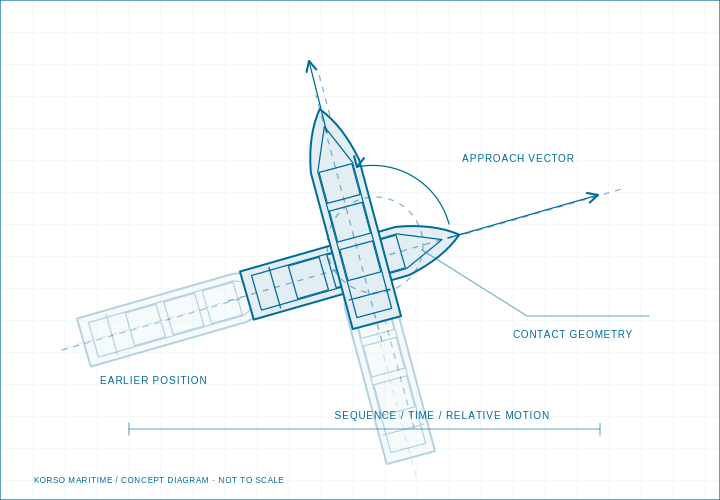
From fragmented records to an event sequence
Positions, speeds, trajectories and contact geometry are compared with the physical damage and recorded timeline.
The analysis examines what happened first, how the event progressed and which scenarios are consistent with the available evidence. Missing or conflicting data are identified where they limit the reconstruction.
Correlate independent sources
The reconstruction draws on the records and material available for the assignment.
Physical findings
Damage patterns, contact geometry, deformation and the interaction of cargo, machinery or structures.
Operational records
Vessel data, AIS logs, loading conditions, bridge recordings, Statements of Facts and witness accounts.
Environmental conditions
Wind, current, sea state and their influence on the vessel or operation.
Typical reconstruction assignments
The method applies to incidents involving the vessel, its cargo and the surrounding infrastructure.
Vessel & port contact
Collisions, groundings, berthing and mooring incidents, and contact with port structures.
Cargo & lifting operations
Handling impacts, crane accidents, cargo movement and resulting structural damage.
Loss of control
Stability loss and casualties involving interacting operational and weather-related factors.
Failure mechanism and event sequence
Forensic investigation and accident reconstruction address complementary technical questions.
Depending on the instruction, outputs may include a documented timeline, trajectory diagrams, force estimates and scenario comparisons.
| Forensic investigation | Accident reconstruction |
|---|---|
| Why did the component or system fail? | How did the casualty develop? |
| Failure mechanism and material behaviour | Movement, timing and interactions |
| Initiating cause and contributing conditions | Sequence from initiating event to final damage |
An assignment starts with a conversation.
Let’s examine
the facts.
For enquiries and assignment requests, please use the contact form.
For urgent matters, please call us directly by phone or WhatsApp.
If your call does not connect, please send a WhatsApp message. Mobile reception may be limited on board vessels or at industrial sites.