
The investigative approach
Read the damage. Test the explanation.
Experience directs attention. Evidence determines what the investigation can conclude.
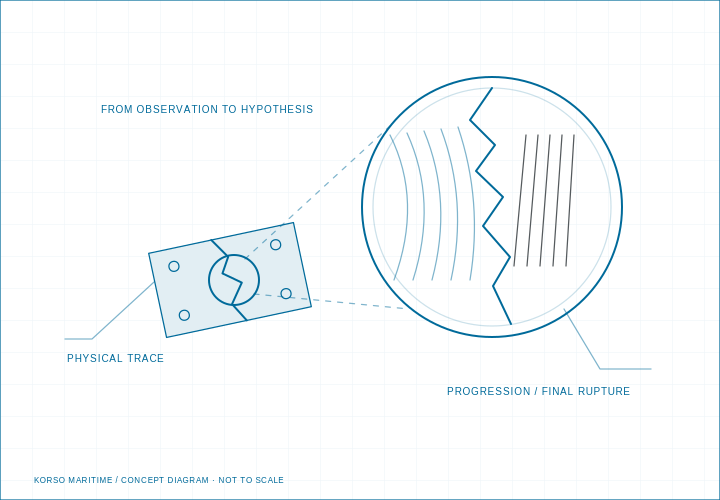
The important decisions begin on site
An inspection is also an opportunity to identify which evidence the final analysis will need.
Recognise patterns
Examine deformation, fractures, wear and contamination for clues to the underlying mechanism.
Capture the decisive detail
Select measurements, photographs, samples and records while the evidence remains accessible.
Adapt the investigation
Refine the technical questions as findings emerge and identify where specialist testing is needed.
Treat the first explanation as a hypothesis
The emerging account is compared with physical evidence, operational records and engineering constraints.
Mechanical, material, chemical or environmental principles are selected according to the case. Conflicting findings are examined; unresolved gaps remain visible in the assessment.
Keep the reasoning structured
A six-stage framework connects preparation, evidence capture, interpretation, modelling, witness correlation and final synthesis.
The framework provides consistency while allowing the investigation to follow the particular technical circumstances of the casualty.
An assignment starts with a conversation.
Let’s examine
the facts.
For enquiries and assignment requests, please use the contact form.
For urgent matters, please call us directly by phone or WhatsApp.
If your call does not connect, please send a WhatsApp message. Mobile reception may be limited on board vessels or at industrial sites.