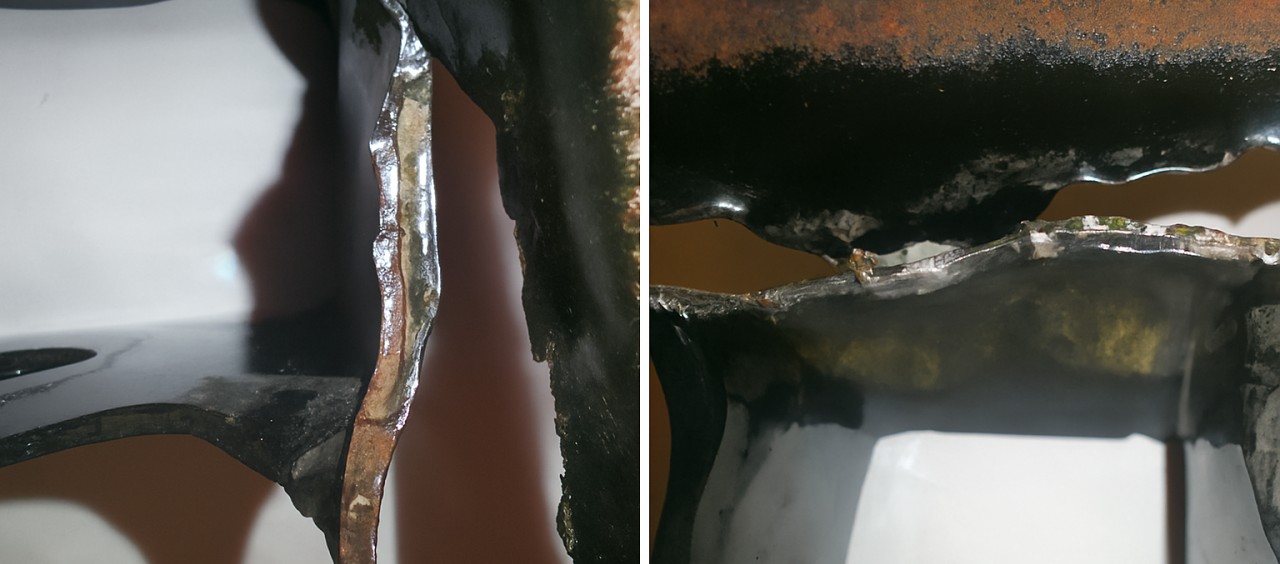
Beneath the rust and the shards, metal preserves the imprint of every stress - like a journal etched into matter. Metal never breaks without reason: it holds within the precise trace of what led to its failure.
Expertise is not just a technical skill. It is an attitude of curiosity and rigor that follows us everywhere: in the ports, in the garages, and even over a cup of coffee. A good expert always struggles not to analyze the little things in everyday life… and maybe that's what true passion is.
At the end of the day, I call a friend to meet for coffee. His answer surprises me: "I'm at the garage, they're changing my suspension subframe." What was supposed to be a casual meeting turned into a dive into the world of expertise… but this time, not maritime, automotive.
The eye of the expert never rests. I couldn't help but observe. I discovered a cracked subframe bracket: an irregular break, two very distinct zones. On the left, a clean, shiny fracture. On the right, a fibrous, stratified rupture.
My reflex as an expert: caliper measurements (3.0 mm), technical hypothesis. The conclusion was clear: a compliant part, but weakened by repeated stresses. The suspension change and an unbalanced tightening were the final touch that precipitated the failure.
In the maritime world, I learned that metal always tells a story. Hulls speak through their cracks. Structures reveal their weaknesses through their fractures. And in automobiles, it's the same. Metal doesn't lie. You just have to know how to listen.
By observing these two zones, we understand that failure is never random. It is the result of a silent story, made of accumulated stresses and one final fatal effort. Expertise is about reading that story and passing it on.
1. Fibrous / dark side
Appearance: rough, stratified, sometimes darkened.
Origin: progressive mechanical fatigue.
Explanation: the metal underwent repeated micro movements, creating internal cracks that slowly propagated. This is the part that tells the long story of stress, invisible in daily use but accumulated over time.
2. Shiny / clean side
Appearance: smooth surface, metallic shine, sharp break.
Origin: final rupture due to sudden overload.
Explanation: a force too strong (e.g. improper torque tightening, shock, imbalance) finished the part in a single instant. This is the part that tells the moment of failure, the instant when the metal could no longer resist.
Many believe that a simple wheel balancing or alignment is enough to fix suspension problems. But the truth lies elsewhere: without precise torque tightening, the part is doomed to suffer abnormal stresses. The torque wrench ensures compliance with manufacturer values, making sure each bolt is tightened neither too much nor too little.
Over tightening crushes the silentblock and stiffens the bracket, leading to mechanical overload. Under tightening allows micro movements that cause progressive fatigue and cracks. In both cases, the bracket eventually fails, even if the alignment is perfectly adjusted.
"So next time a mechanic tells you 'there's no need to torque it properly,' maybe he just doesn't feel like it. But your subframe… it will remember."