As a maritime expert accustomed to working with precise references such as time, distance, and coordinates, one detail has always bothered me about how we count centuries: why does the first century begin at year 1 instead of zero? And more broadly, why does no century contain years that start with its own number?
Observe this paradox:
- 18th century = 1701-1800 (no year starting with "18...")
- 19th century = 1801-1900 (no year starting with "19...")
- 20th century = 1901-2000 (no year starting with "20...")
- 21st century = 2001-2100 (no year starting with "21...")
This systematic offset creates permanent confusion between the century number and the years it contains.
The Scientific Perspective
From a scientific perspective, particularly in physics and navigation, all temporal measurements begin at zero. A chronometer starts at 00:00:00, never at 00:00:01. In mathematics, the origin of a coordinate system is at point (0,0), not at point (1,1). In computer science, array indexing starts at 0. This principle is logical, intuitive, and universal: zero represents the starting point, not an already acquired value.
However, the Gregorian calendar, designed several centuries ago, has no year zero. Year 1 corresponds to the first year of our era, which means the 1st century spans from year 1 to year 100. Each century follows this logic, creating an offset between the century number and the years it contains.
The Historical Context
An essential historical point must be clarified: in 1582, when the Gregorian calendar was established, Christian Europe had not yet fully integrated the mathematical concept of zero into its thinking system. Although Arab mathematicians had been using zero for centuries (introduced by Al-Khwarizmi in the 9th century), this concept was still largely ignored or misunderstood in the West at that time. This is the main reason for this anomaly: one cannot conceive a system based on a concept one has not yet mastered.
This historical convention is counter-intuitive, especially for those accustomed to modern measurement systems. It's a bit like a baby being 1 year old at birth, or starting a chronometer at 00:00:01 instead of 00:00:00. The system works, but it is scientifically flawed.
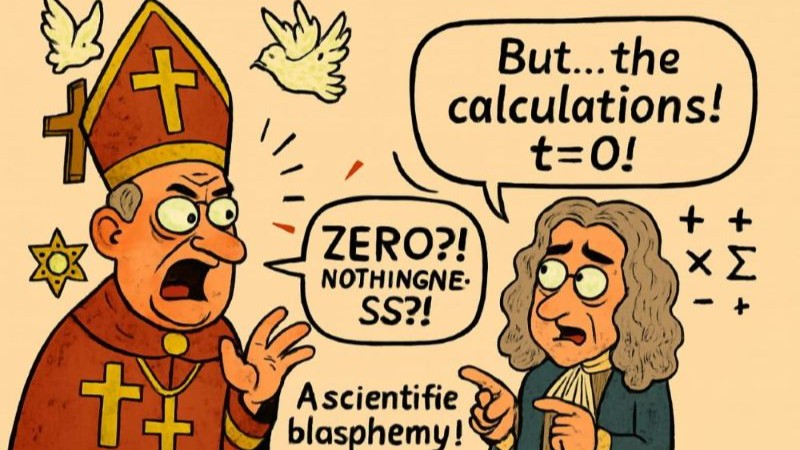
Imagine Newton, nearly a century later, attempting to convince the Church to correct this anomaly inherited from 1582:
The Church: "The calendar has worked perfectly well since 1582, why change it?"
Isaac Newton: "But it starts at year 1! We should have put a year zero for mathematical consistency!"
The Church: "The ONE! Jesus is the ONE, the Unique, the one who comes to save humanity! We cannot start with nothingness!"
Isaac Newton: "But... the calculations... Every measurement begins at zero! A chronometer doesn't start at 1 second!"
The Church: "The calendar has been established for a century, calculations will pass, faith will remain. Next!"
Could We Change It?
One could imagine reintroducing a century zero, which would allow recalibrating the numbering to better correspond to number logic and our visual references. That said, changing a millennial convention would be difficult, if not impossible, as it is so deeply rooted in our culture.
This paradox illustrates well how certain historical conventions persist despite their scientific inconsistency. It reminds us that our way of counting time is as much a cultural construction as it is a rigorous system - a historical bug that can no longer be patched!