It is 3:30 in the morning when the chief officer raises the alarm. In the middle of a bulk wheat discharge operation at an Algerian port, a section of the hoisting wire rope on crane No. 3 has abnormally slackened — a loop sagging like a limb giving way under too heavy a load. Operations stop immediately.
1. The Context
On board is a bulk carrier flying the flag of the Marshall Islands, tasked with delivering its grain cargo. The shipowner, covered by his P&I Club, immediately instructs a local marine survey office to conduct the investigation. The cargo receiver, for her part, has already put her concerns about anticipated delays in writing. The stakes are multiple: identify the cause of the casualty, determine liability, and enable the resumption of operations as quickly as possible.
2. The Crux of the Problem
At first glance, the question seems straightforward: the wire rope failed — but why? In the world of maritime lifting, appearances are rarely sufficient. The rope had not snapped — it had simply yielded, losing its tension in a localised area. This detail would prove central.
Two lines of inquiry immediately presented themselves: a mechanical failure linked to the equipment, or an exceedance of the authorised load limit. But a third dimension — more insidious — would quickly emerge: that of deferred maintenance and inadequate monitoring.
The crane in question was an electro-hydraulic deck crane with a nominal capacity of 30 tonnes. The hoisting wire rope, a 30 mm diameter galvanised non-rotating rope, had been certified and installed in September 2020. Its Minimum Breaking Load (MBL) was 763 kN, equivalent to approximately 77.8 tonnes. With a safety factor of 5/1, the authorised Working Load Limit (WLL) was therefore 15.56 tonnes — not one tonne more.
3. The Investigation
The Crime Scene: the Hoisting Drum
The inspection begins at daybreak on 10 March 2025. The surveyor proceeds methodically, section by section, armed with a digital calliper and an eye trained to read what metal has to say.
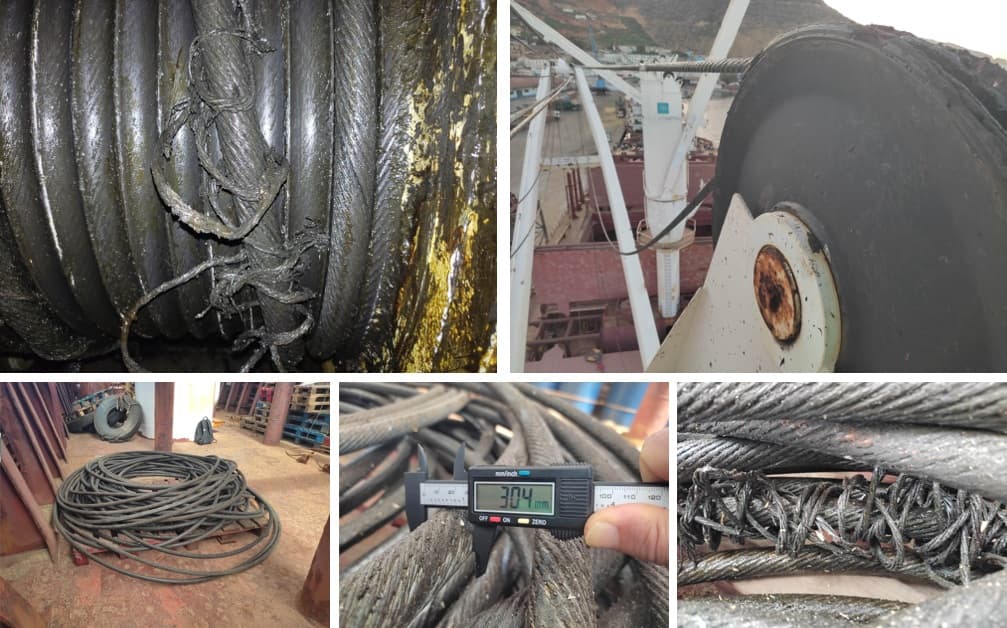
- The section of rope running through the sheaves presents a satisfactory appearance. Measured diameter: between 30.0 and 30.6 mm — within specification. No visible anomalies.
- Then comes the examination of the section wound onto the drum. What the inspection reveals is striking: deep cuts (2 to 3 mm), localised crushing bringing the diameter up to 33 mm (+10% above nominal), detached strands and completely unravelled wires over a damaged length of 1.70 metres.
ISO 4309 — the international standard governing the inspection and discard of lifting wire ropes — is unambiguous: a diameter increase exceeding 6% over a length equal to 6 times the nominal diameter (i.e. 0.18 m for a 30 mm rope) constitutes an immediate discard criterion. Here, the damaged length is 9.4 times greater than that threshold. The rope should have been taken out of service long before the incident.
The Silent Accumulation of Damage
The survey reveals a classic yet formidable phenomenon: the damage predated the incident. The cuts and crushing observed were not the result of a sudden overload — they stemmed from progressive fatigue, concealed by the accumulation of grease and dust during routine visual inspections. The incident merely amplified and exposed what was already present.
Among the contributing factors identified: repeated tension-release cycles on the most heavily stressed section (that in contact with the drum), excessive lubrication which had paradoxically masked the defects, and the probable absence of regular in-depth inspections — a finding reinforced by another troubling fact.
The Expired Class Certificate
The documentary review reveals that the crane's class certificate had lapsed. This is no administrative technicality: a valid certificate guarantees that the equipment has been inspected in accordance with rigorous protocols and is fit for service. Without it, there is no assurance that progressive deterioration would have been detected in time. The expired certificate is identified as an aggravating factor, indicative of an insufficient maintenance culture.
The Load Calculation: the Safety Margin Eroded
The surveyor reconstructs the actual load applied at the time of the incident. The mechanical grab used for grain handling — a two-jaw model with an 11 m³ capacity, for which no technical documentation was available — is estimated at approximately 10 tonnes unladen. The wheat cargo contained within the grab represents, based on a stowage factor of 45 ft³/tonne, approximately 8.63 tonnes.
Estimated total load: 18.63 tonnes. Against a WLL of 15.56 tonnes, the exceedance reached 3.07 tonnes, nearly 20% beyond the authorised limit. This exceedance, in a context where the rope was already structurally compromised, acted as the detonator of a time bomb.
The Mechanics of Failure
The physical analysis reconstructs the sequence of events with precision: the damaged zone on the drum had locally lost its axial rigidity. Under the combined effect of the excessive load and the dynamic movements of the grab, tension could no longer be maintained uniformly across that section. The rope, insufficiently constrained to remain seated in the sheave groove, underwent lateral instability — it deviated from its path, causing the visible sagging reported by the chief officer.
The physics of wire ropes is unforgiving: it is not rupture that occurs first, but loss of guidance. And it is precisely this sagging — a providential warning signal — that allowed operations to be halted before a far more serious accident could occur.
4. The Conclusion
The investigation establishes a convergence of three causal factors:
- 1. Pre-existing defects in the wire rope, far exceeding the discard criteria defined by ISO 4309, which had gone undetected due to insufficient maintenance and superficial inspections.
- 2. An exceedance of the Working Load Limit, resulting from the use of an oversized grab relative to the certified capacity of the rope — an operational choice whose consequences had been underestimated.
- 3. An expired class certificate, reflecting a failure of the periodic inspection regime for lifting equipment.
The rope is replaced on the same day, and the crane declared fully operational the following afternoon, following electrical checks and complete functional testing.