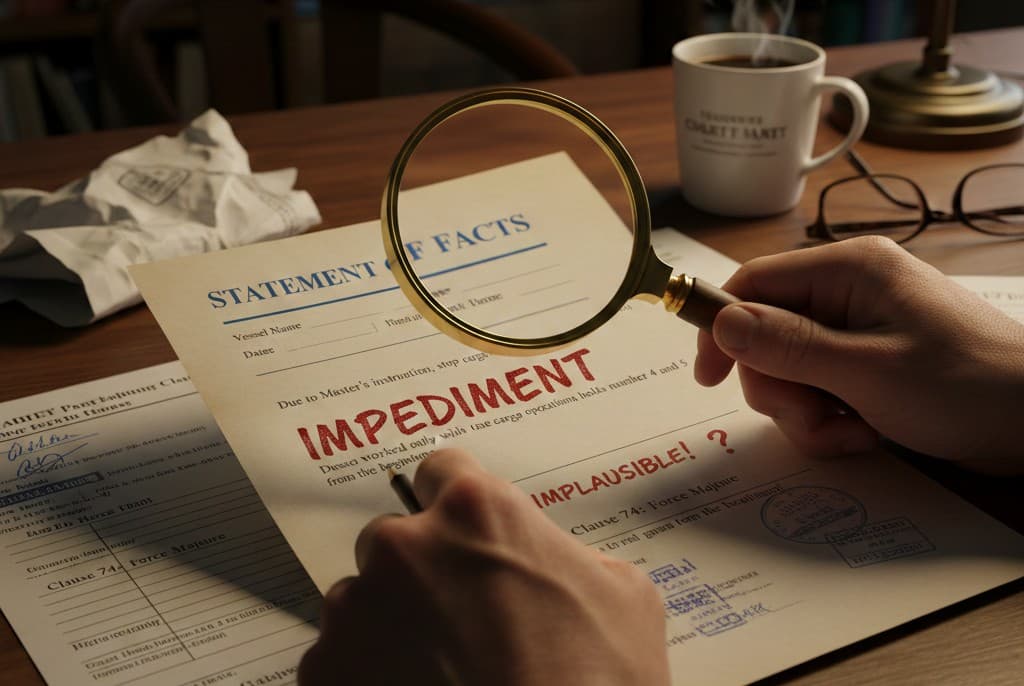
A bulk carrier has just completed the discharge of over 35,000 metric tons of corn at an Algerian port. Eleven days of operations, three shifts a day, five holds worked in rotation. On the surface, a routine voyage. But when the final paperwork lands on the shipowner's desk, something stands out: a 50% laytime deduction has been applied to a specific eight-hour window, amounting to USD 6,718.76.
1. The Context
The justification? Two remarks inserted into the Statement of Facts by the local port agent, attributing the slowdown to instructions allegedly given by the vessel's Master. The shipowner contests the deduction and instructs a marine surveyor to conduct an independent documentary review. No physical inspection is required — the battlefield here is not the ship's hold, but the written record itself.
2. The Crux of the Problem
The Statement of Facts — known in the trade as the SOF — is a seemingly mundane document. Prepared by the port agent, it logs the chronology of cargo operations shift by shift: start times, stop times, number of gangs working, quantities discharged. In laytime disputes, it is often the primary — sometimes the only — document used to calculate demurrage or despatch. Its words carry financial consequences.
In this case, the SOF contained two specific entries for 12 June 2025:
- "Due to Master's instruction, stop cargo operations holds number 4 and 5 on 12/06/2025 from 11:00 till 19:00."
- "Due to Master's instruction, vessel worked only with one gang on the 3rd shift from the beginning."
Read at face value, these entries paint a picture of a Master arbitrarily disrupting his own vessel's discharge operations — a characterisation that, if accepted, would squarely place the resulting delay at the shipowner's door. But the Master had written his own remarks directly onto the SOF, in his own hand. And his account told a very different story.
3. The Investigation
What the Master Actually Wrote
The Master's handwritten annotation on the SOF reads, in substance: a shore crane broke down on 12 June, struck Hold No. 4, caused structural damage, and created a risk to the vessel's stability. Operations in Holds 4 and 5 were suspended — not on a whim, but as a direct safety response to an external incident beyond the vessel's control. He used a specific word: "impediment." Not a decision. Not an instruction in the discretionary sense. An impediment — something imposed from outside. This single word, buried in the remarks section of a routine port document, became the forensic anchor of the entire analysis.
The SOF Under the Microscope
The documentary review proceeds with a straightforward but revealing comparison: every significant entry in the SOF is cross-referenced against the Master's remarks, the known operating protocols of Algerian ports, and the applicable contractual provisions.
- The first entry — attributing the hold stoppage to a "Master's instruction" — is technically accurate in the narrowest sense: the Master did indeed give the order to suspend operations. But the SOF omits the reason for that order entirely. There is no mention of the crane breakdown. No mention of the structural impact to Hold No. 4. No mention of the stability risk that triggered the suspension. The causal chain has been severed, leaving only the effect — and a misleading attribution of responsibility.
- Under any standard of fair documentation, the omission of the root cause from a record used to calculate financial liability is a material deficiency. In maritime practice, it is precisely the kind of incomplete reporting that shifts money from one party's pocket to another's — not through fraud, necessarily, but through selective narration.
- The second entry — attributing the single-gang deployment on the night shift to a "Master's instruction" — is even more problematic. The Master flatly denied issuing any such instruction. More significantly, the surveyor notes that gang assignment is a matter of port and stevedoring company authority, not ship's command. In Algerian ports, as in most international ports, the number of gangs deployed per shift is determined by the agent and the terminal operator. A ship's master has no administrative power to reduce the stevedoring workforce — that is simply not within his remit. The entry is not just disputed; it is operationally implausible.
The Contract as Compass
The original charter party for the vessel was not available. However, a charter party from a sister vessel of identical ownership and operational profile was provided as a comparative reference — a common and accepted practice in documentary disputes where the contractual architecture is structurally identical.
- Clause 74 of that charter party addresses force majeure in comprehensive terms, explicitly providing that delays resulting from "breakdowns, power failure, accidents, or stoppages whether total or partial, at ports" shall neither count as laytime nor as demurrage. The language is clear and its application to the facts is direct: a shore crane breakdown causing physical damage to a vessel's hold is, by any reasonable reading, precisely the kind of port-side accident this clause was designed to cover.
- The Master's safety-driven suspension of operations in the affected holds was not a discretionary act subject to laytime counting — it was a legally and professionally required response to an external event expressly excluded from laytime under the contractual terms.
- A second clause, governing the appointment of port agents, confirms that the agent who prepared the SOF was nominated by and acting on behalf of the charterers. This does not imply bad faith — but it does mean that the SOF cannot be treated as a neutral, independent record. When an agent's principal has a financial interest in the laytime calculation, omissions that favour that principal deserve scrutiny.
- Finally, the arbitration clause provides that any unresolved dispute falls under London arbitration with English law governing. Under English maritime law, laytime disputes turn on precise causation and objective documentary evidence. A SOF that omits the originating cause of a delay, and attributes that delay to the vessel's command on grounds that are operationally implausible, would face serious challenges in any LMAA proceeding.
4. The Conclusion
The documentary analysis leads to a clear finding: the USD 6,718.76 laytime deduction is unjustified, both factually and contractually. The eight-hour stoppage on 12 June 2025 was caused by a shore crane failure — an event entirely outside the vessel's control, falling squarely within the force majeure exclusions of the charter party. The Master's response was not an operational choice; it was a safety obligation. The SOF, as drafted, presents a partial and misleading account of events by omitting the crane breakdown entirely and attributing its consequences to the vessel's command.
The single-gang deployment attributed to the Master's instruction lacks any plausible operational basis, given that workforce scheduling is the exclusive domain of the agent and stevedoring company.
The surveyor's recommendations are practical and proportionate: a formal letter of protest, a request for laytime recalculation excluding the affected period, a request for written confirmation of the crane failure from the port or stevedoring company, and notification to the charterers of the inconsistencies in the SOF prepared by their own nominated agent. If negotiations fail, the contractual path to London arbitration remains open — and the legal ground, on this evidence, is solid.