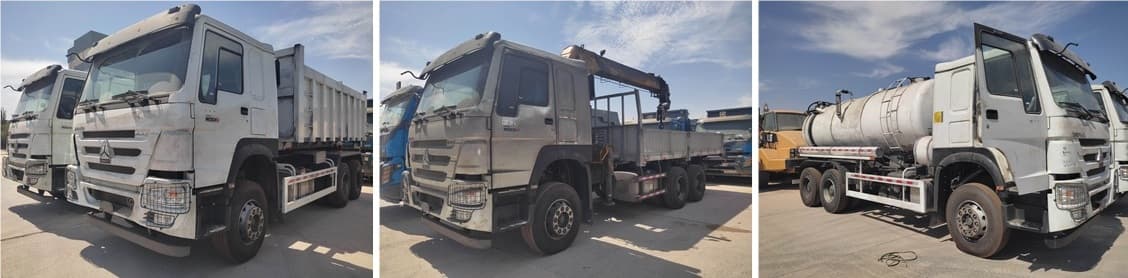
They had crossed half the world. Loaded at an industrial port in East Asia, three brand-new industrial vehicles — a tanker truck, a dump truck, and a truck fitted with an auxiliary crane — were making their long sea voyage toward an Algerian port. Heavy machinery, manufactured in China, purchased new, expected on a worksite. Total cargo value: nearly $250,000. Upon arrival, the delivery turns into a silent disaster.
1. The Context
The three trucks, originally an immaculate white, are uniformly coated in a black, greasy, granular deposit. The cabs reek of smoke. The dashboards, textile upholstery, ventilation ducts — everything has been permeated. No bent panels. No broken glass. No visible mechanical impact. But something happened in the belly of that vessel. And the insurer appointed a maritime expert to find out exactly what.
2. The Crux of the Problem
At first glance, the file seems straightforward: the vehicles are dirty, the carrier has provided an explanatory letter, the cost of cleaning needs to be assessed and the case closed. But several grey areas remain.
- First ambiguity: the nature of the damage. Have the vehicles sustained surface damage — mere soiling — or a deep-seated alteration likely to compromise their functional integrity? The distinction is crucial: a basic exterior wash costs nothing like a full dashboard removal with steam treatment of internal circuits.
- Second ambiguity: the carrier's letter. The maritime carrier did provide a letter, drafted in two languages — English and Mandarin — acknowledging an incident on board. But the two versions do not say exactly the same thing. The English version, approximate in its phrasing, invites the consignee to "proceed with cleaning" — with no commitment to bearing the cost. The Chinese version, more precise, acknowledges the intensity of the smoke and its greasy nature. Which version prevails? Which one genuinely reflects the carrier's position?
- Third ambiguity: the skips. Initially, only one independent skip body was mentioned in the declared claim. As the mission unfolds, it emerges that fifteen skip bodies were in fact affected. They had already been cleaned and repainted in-house. No invoices. No quotes. No direct inspection possible.
3. The Investigation
Arriving Without Preconceptions
The inspection takes place on site, in the company's vehicle yard, on a July day with temperatures reaching 35°C. Three hours of meticulous examination across three vehicles — immobilised since delivery, untouched and uncleaned. The methodology is threefold: visual, tactile, olfactory. This sensory triptych, well-established in smoke damage surveys, allows an event to be reconstructed from its physical traces — much like a forensic pathologist reads a body.
What the Visual Examination Reveals
- The first striking finding: the soot deposits are perfectly uniform, including in naturally sheltered areas — recesses, wheel arches, the underside of the chassis. This detail is fundamental. A direct heat source leaves oriented traces, gradients, shadow zones. A gaseous diffusion in a confined space, by contrast, coats everything uniformly, with no distinction between exposed and protected surfaces.
- Second finding: no direct thermal alteration whatsoever. No paint blistering. No deformed plastics. No signs of radiant heat. The vehicles did not burn. They were enveloped by smoke.
- Inside the cabs, the examination reveals deep penetration of deposits: blackened ventilation ducts, grimy control buttons, textiles impregnated to the core of their fibres. The smell is immediate, persistent, characteristic of the incomplete combustion of polymers and hydrocarbons. It does not come from the surface — it comes from within.
What the Physical Chemistry Tells Us
The carbon particles produced by a vehicle fire — tyres, plastics, wiring — do not behave like ordinary dust. They are polar, which gives them a chemical adhesion to metal surfaces, plastics and textile fibres. They combine with tarry condensates that anchor them durably in place. And they slowly release volatile organic compounds — hence the persistent odour, amplified in enclosed spaces like a cab. This physicochemical behaviour explains both the depth of penetration and the difficulty of cleaning: a simple surface pressure wash is simply not enough.
What the Documentary Analysis Reveals
The bill of lading clearly establishes that the vehicles were loaded in good condition — new, with no reported defects. The carrier's document confirms the incident: a spontaneous combustion of another vehicle in the same hold, generating a substantial quantity of thick, greasy smoke. The comparative analysis of the two linguistic versions of this letter is a delicate but necessary exercise. The English version minimises: it refers to "blackening" and suggests "cleaning." The Mandarin version is more explicit about the nature of the smoke — described as "thick and greasy" — a formulation with significant technical weight. In survey practice, the more precise version serves as the reference for damage assessment. From a legal standpoint, the carrier's acknowledgement of the incident, however cautiously worded, is sufficient to establish a presumption of liability under international maritime law.
The Particular Case of the Skips: Remote Survey
For the fifteen skip bodies — which could not be inspected on site — the expert had access only to photographs taken at the port during unloading. These images show metal surfaces almost entirely blackened, with soiling noticeably more severe than that observed on the physically inspected vehicles. In the absence of supporting documents for the in-house remediation work, a technical estimate is constructed through calculation: surfaces to be treated, paint yield per kilogram, local market material costs. The result is provided as an indicative assessment, with all the methodological caveats that the absence of direct inspection demands. Transparency about the limits of the survey is itself part of the rigour.
4. The Conclusion
The survey conclusively establishes that the three industrial vehicles — and by extension the skip bodies — suffered a prolonged exposure to combustion smoke in a confined space aboard the carrying vessel. The damage does not result from any direct thermal contact. This is a pure smoke casualty, driven by progressive atmospheric impregnation.
The cost of restoring the three vehicles is assessed at 270,000 Algerian dinars, covering high-pressure exterior cleaning and deep interior treatment with partial dashboard removal. A technical reservation is noted for potential electronic or hydraulic failures not detectable at the time of initial inspection — fine particles can affect sensors and control modules over the medium term.
For the skip bodies, the technical estimate for repainting materials reaches 1,050,000 dinars across fifteen units — with the explicit caveat that this figure is indicative, and that the final indemnification decision rests with the insurer.
On the question of liability: the carrier acknowledged the incident. Under the international conventions governing maritime transport, this acknowledgement establishes a presumption of responsibility. Nothing uncovered during the survey supported a finding of force majeure or any recognised exemption ground.