In the autumn of 2025, two steel box pontoons at an Algerian industrial port, critical for berthing large cargo vessels, were the subject of a routine condition survey. The mandate was straightforward: assess structural condition, determine market value, and recommend a path forward. What the investigation uncovered was not a need for maintenance, but a decade-long, silent structural collapse that had rendered both units unsafe for operation.
1. The Context
Commissioned in 2013 and designed for a 25-to-30-year service life, the two pontoons were built from identical plans and classed by a major international classification society. They served as floating receiving platforms, and without them, vessel berthing operations at the facility would simply cease. On the surface, they appeared operational. Decks were freshly painted, fittings in working order. But in marine engineering, surface appearances are notoriously deceptive.
2. The Heart of the Problem
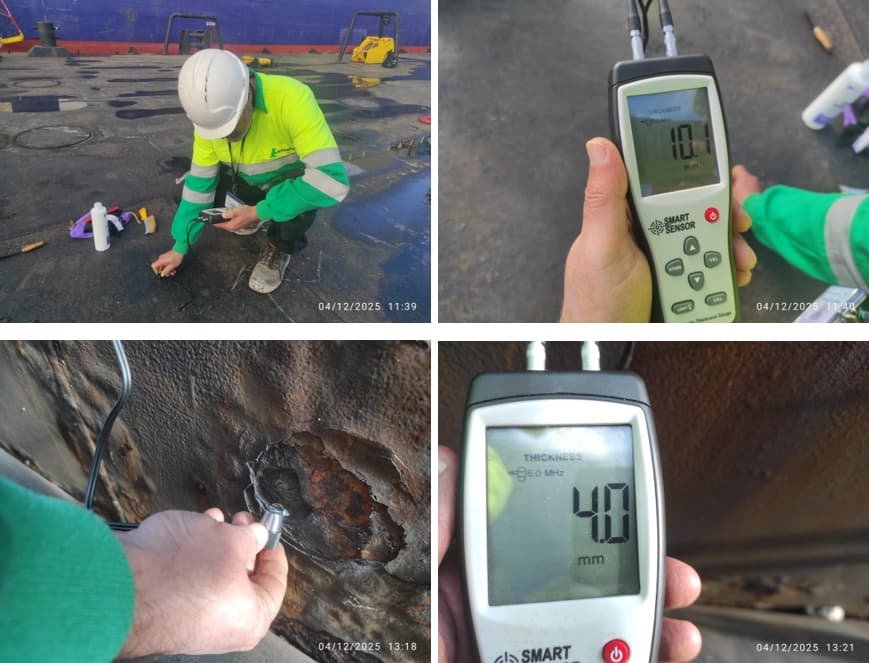
The visual inspection in December 2025 revealed an immediate and striking paradox. The decks were in genuinely satisfactory condition, thanks to recent refurbishment. However, the external shell plating told an entirely different story. It was a catalogue of aggressive corrosion: uniform thinning, deep pitting, honeycomb cavitation, laminar exfoliation, and erosion-corrosion grooves. The original coating had lost adhesion over more than 80% of the hull surface, leaving bare steel exposed to direct seawater attack for years.
3. The Investigation
The Numbers That Changed Everything
Using a calibrated ultrasonic thickness gauge, the survey team performed systematic surface preparation at each of the 64 measurement points across both pontoons. The results were unambiguous. The original 8 mm shell plating had been reduced to an average of 4 mm or less. Across 52 measurements on the hull, not a single reading fell below 50% thickness loss. The worst-affected points registered losses of 61.3%, leaving just 3.1 mm of steel. Every single measurement on both structures fell into the "UNSAFE" category according to classification society criteria.
The Silent Anodes
Each pontoon was fitted with 50 aluminum sacrificial anodes, sized to provide four years of protection. After 13 years of service, they should have been replaced multiple times. Instead, the survey team found wear of only 15 to 20%. Hull potential measurements averaged -560 mV, far above the protection threshold of -800 mV for steel in seawater. The anodes had been electrically isolated from the hull from early in their service life, leaving the steel to corrode freely for thirteen uninterrupted years.
4. The Physics of Failure
A 50% thickness loss sounds significant, but the engineering reality is catastrophically worse. Steel plate structural capacity does not degrade linearly. Bending strength is proportional to the square of thickness, and stiffness to the cube. For the 8 mm shell plating now averaging 4 mm, this translates to a 75% loss of bending strength and an 87.5% loss of stiffness. At 60% loss, only 16% of original bending strength and 6.4% of stiffness remained. The safety factor had dropped below 1.0, meaning the structure could fail under normal operating loads without warning.
5. The Decision the Data Drove
With a replacement value of ~$380,000 per new unit and a current scrap value of ~$30,000, the observed depreciation stood at 92.1%. A comprehensive repair option was costed at approximately $470,000 per pontoon, significantly more than a new unit at $407,000. Factoring in the high probability of budget overruns, the realistic cost was assessed at between $650,000 and $835,000 per pontoon. Ten out of ten criteria favored replacement.
6. The Conclusion
The investigation established, with scientific certainty above 95%, that both pontoons had long since crossed the threshold of structural safety. The structures were formally classified UNSAFE under IACS criteria, and their continued operation constituted a genuine risk to personnel, the environment, and port operations. The recommendation was unambiguous: immediate cessation of operations, formal decommissioning, and replacement.
7. The Lesson That Goes Beyond This Case
This investigation illustrates a pattern that recurs with troubling frequency: selective maintenance. The visible, accessible surfaces received attention, while below the waterline, a decade of unchecked corrosion consumed the structural substance. The cathodic protection system, designed to fight this invisible war, failed silently from the outset. The most expensive maintenance failures are often the ones that make no noise at all.