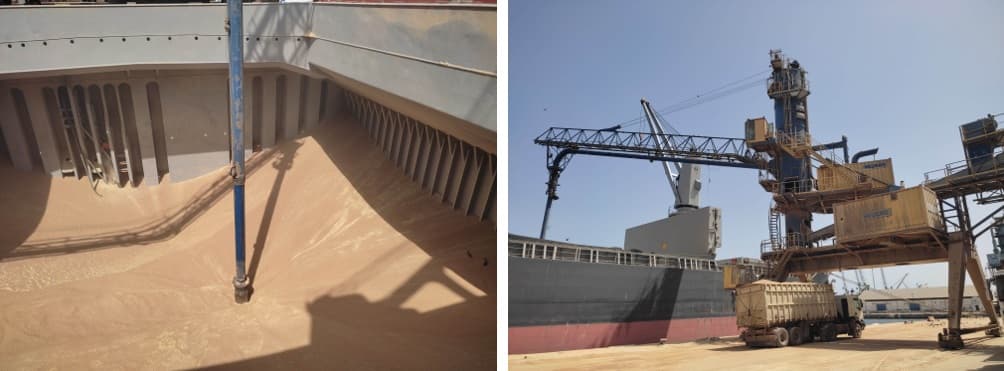
A bulk carrier has just completed her approach to an Algerian port, carrying nearly 29,000 metric tons of soft milling wheat loaded in Ukraine. The discharge operations begin without incident. Then, two days in, an unexpected notification lands: the port authority's insurer is alleging that the vessel caused damage to port equipment during discharging operations — and is threatening conservatory arrest proceedings should the damages prove substantial.
1. The Context
The shipowner and his P&I Club react immediately, instructing a marine surveyor to attend on site and represent their interests. Time is of the essence: the vessel is still at berth, the claim is escalating, and the threat of arrest hangs in the air.
2. The Crux of the Problem
From the outset, something does not add up. The notification from the port's insurer describes the damaged equipment as a gantry crane. But when the surveyor arrives at the quayside, he finds himself looking at something else entirely: a pneumatic bulk discharger — a suction pump used for extracting loose grain from the ship's holds.
This is not a trivial distinction. A gantry crane and a pneumatic discharger operate on entirely different mechanical principles, are subject to different failure modes, and require fundamentally different forensic approaches. The misidentification, in itself, raises the first red flag about the reliability of the opposing party's account.
The port authority's theory, as it emerges through discussions on site, is that the vessel's cargo had ingested a metallic foreign object into the suction circuit, causing the compressor to overheat and ultimately destroying an internal gear wheel and timing chain. The vessel, they argue, should be held liable. But there is a second, equally striking detail: when the surveyor arrives to inspect the allegedly damaged and inoperative equipment, the suction pump is running at full capacity — actively discharging wheat from one of the ship's holds.
3. The Investigation
A Machine That Refuses to Stay Broken
The pump had reportedly been repaired and returned to service the day before the surveyor's attendance. Far from being a reassuring sign, this fact is immediately significant: the rapid restoration of a supposedly severely damaged piece of heavy industrial equipment, without any formal joint inspection having taken place, severely undermines the credibility of the damage claim. What was the true extent of the damage? On what basis was the repair carried out? These questions remain unanswered.
The surveyor requests a joint adversarial survey — the standard practice in maritime casualty investigations involving multiple parties, designed to ensure that findings are established transparently and on a contradictory basis. The opposing surveyor, appointed by the port's insurer, declines. His mandate, he explains, is limited to assessing damages for his principal. No joint inspection will take place. The implications are significant: any unilateral findings issued by the opposing party will carry reduced evidential weight and cannot be considered binding.
The Evidence That Was Not There
A meticulous visual examination of the pneumatic circuit follows. The surveyor inspects both the rigid and flexible pipelines through which any allegedly ingested metallic object would have had to travel before reaching the compressor. The findings are unambiguous: no perforations, no dents, no deformations, no blockages at any elbow or flange connection.
This is a critical observation. In any pneumatic bulk transfer system, a metallic foreign object carried at high velocity through the suction circuit would inevitably leave traces along its path — deformations at bends, impact marks at narrowing sections, or at the very least a localised blockage. The complete absence of such intermediate damage makes the ingestion hypothesis, from a purely mechanical standpoint, implausible.
When asked to produce the alleged foreign object — the purported cause of the entire incident — the port authority offers nothing. No metallic body is presented. No dismantling report is shared. No photographic evidence of internal damage to the compressor is provided.
The Physics of the Failure
With the ingestion theory effectively dismantled by the absence of physical evidence, the surveyor turns to the alternative explanations that the observed facts point toward.
- The pump reportedly failed after just ten minutes of operation. This timeline is telling. Industrial compressors of this type — high-power units designed for continuous duty cycle — do not succumb to external foreign body ingestion within the first ten minutes of service. What they can succumb to, within that timeframe, is a failure to follow the prescribed start-up sequence.
- These machines require a progressive warm-up: an initial no-load phase to circulate lubricating oil, a gradual rise in operating temperature, and a controlled ramp-up of load before full capacity is engaged. A direct cold start under full load bypasses this protection entirely, leaving critical internal components — gears, chains, bearings — exposed to metal-on-metal contact without adequate lubrication. The result can be rapid and catastrophic internal failure, entirely unrelated to anything that has happened in the cargo hold.
- Furthermore, these systems are equipped with an array of protective mechanisms — relief valves, thermal sensors, emergency shutdown actuators — specifically designed to interrupt operations before overheating can cause irreversible damage. No evidence was provided that any of these devices had triggered, which further weakens the hypothesis of a progressive failure caused by a blocked circuit.
The overall picture points consistently toward a pre-existing mechanical issue, inadequate maintenance, or improper operating procedures — none of which bear any connection to the vessel or her cargo.
4. The Conclusion
The investigation establishes, on the basis of factual observation and technical reasoning, that the vessel bears no responsibility for the malfunction of the port's suction pump. Four convergent findings support this conclusion:
- First, there is a total absence of material evidence: no foreign object, no dismantling report, no documented traces of ingestion damage along the pneumatic circuit.
- Second, the physical inspection of the pipelines reveals no intermediate damage consistent with the passage of a metallic body.
- Third, the failure timeline — ten minutes into operation — is far more consistent with an internal mechanical cause than with any external event linked to the cargo.
- Fourth, the rapid restoration of the equipment to service, before any joint inspection could take place, severely compromises the credibility of the claimed severity of damage.
The refusal to conduct a joint survey adds a procedural dimension to these technical findings: in the absence of contradictory expert findings, the unilateral report of the opposing party cannot be treated as established fact.
The vessel sails without arrest. The claim, built on a misidentified piece of equipment and a theory that the evidence does not support, does not survive scrutiny.