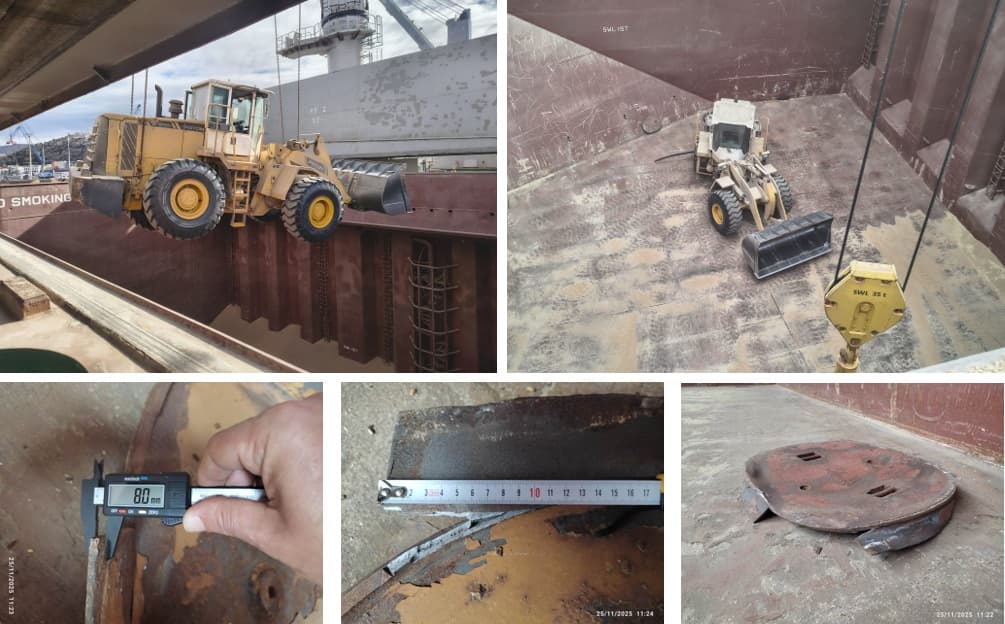
A bulk carrier arrives at an Algerian port carrying over 31,500 metric tonnes of Romanian soft milling wheat, 2025 harvest. The vessel berthed smoothly, port formalities completed without incident, and discharge operations commenced as planned the following morning. For several days, the operation proceeded normally. Then, during the final stages of discharge — the most delicate phase of any bulk unloading operation — something went wrong inside the holds.
1. The Context
The master issued a Letter of Protest. Two ballast manhole protection covers, located in cargo holds No. 2 and No. 4, had been bent and cracked. The surveyor was appointed and boarded the vessel the following day. What appeared at first glance to be a straightforward damage claim would reveal a more complex and technically fascinating question: not just what broke, but why it was almost inevitable that it would.
2. The Crux of the Problem
The damages were not disputed. They were visible, measurable, and clearly fresh. What needed to be established was the mechanism of causation — and more critically, whether the damage was the result of an unfortunate accident or the foreseeable consequence of a questionable operational choice. At the heart of the matter lay a single question: what equipment was used during the final stages of discharge, and was it appropriate for the task?
The final phase of bulk cargo discharge is a well-known critical moment in stevedoring practice. As the volume of grain diminishes, the hold floor — the tank top — becomes progressively exposed. Structural fittings that were previously buried under thousands of tonnes of wheat re-emerge: manholes, ladders, pipes, protective covers. These elements are not designed to withstand heavy mechanical contact. They are, in effect, sitting targets. And the choice of machine operating in that confined, increasingly exposed space matters enormously.
3. The Investigation
Down Into the Holds
The survey was conducted during daylight, with cargo operations suspended or completed, allowing safe access to both affected holds. The inspection was non-destructive — no dismantling, no material sampling — relying entirely on close-up visual examination, photographic documentation, and precise dimensional measurement. The damaged components are ballast tank manhole protection covers: oval steel plates, approximately 8 mm thick, fitted with a peripheral reinforcing border, installed flush with the tank top. Their function is simple but vital — to shield the watertight ballast tank manholes beneath from mechanical impact during cargo operations.
Reading the Damage
- In Hold No. 2: the peripheral border was torn over a length of 29 centimetres. The steel plate, normally flat, had been driven inward, forming a pronounced concave — or "dished" — profile. The maximum measured deflection: 39.9 mm.
- In Hold No. 4: a similar tear, 10 centimetres long. The inward deformation was even more severe, with a maximum measured deflection of 60.7 mm — nearly the thickness of seven of the steel plates stacked together.
These are not scratch marks. They are not the result of gradual wear, corrosion, or minor contact. The damage patterns — the geometry of the deformation, the nature of the tears along the weld seam, the orientation of the impact marks — are entirely consistent with a single, high-energy mechanical impact from heavy equipment. The forensic reading of the metal tells a clear story. Critically, the underlying watertight ballast tank manholes remained intact. No leakage, no cracking of the hull structure, no compromise to the vessel's seaworthiness. The damage was real and material, but contained. The protection covers had done their job — they had absorbed the blow and sacrificed themselves so that the watertight closures beneath would survive.
The Equipment Question
Interviews with the vessel's officers confirmed what the physical evidence suggested: the final stage of discharge had been carried out using a heavy wheeled loader — a large, articulated machine in the 12 to 17-tonne class, designed for high-capacity bulk handling. This is where the investigation becomes technically illuminating.
Industry best practice, well established in port and stevedoring operations worldwide, is clear on this point: the final stages of bulk discharge — when the hold floor is exposed and structural fittings become vulnerable — should be carried out using compact, lightweight, highly manoeuvrable machines, such as skid-steer loaders. Small, agile, weighing around 2.4 tonnes, with excellent visibility of deck-level fittings and limited impact energy.
The Physics of the Matter
The comparative force analysis tells the story with mathematical precision. Under comparable operating conditions:
- The heavy wheeled loader generates 8 to 9 times more impact force than a compact skid-steer loader.
- In terms of kinetic energy — the energy transferred during a collision — the disproportion reaches a factor of 29 (784 joules versus 27 joules).
To put this in structural terms: the stress generated by the lighter machine on an 8mm steel plate remains comfortably below the material's yield strength. The steel flexes elastically and recovers. With the heavy loader, once dynamic amplification factors are applied — as required under DNV engineering standards for impact events — the loads imposed on the plate exceed the plastic collapse capacity of the component by a factor of 4 to 5.
The structural failure was not a matter of bad luck. It was, in the language of engineering, the predictable and inevitable consequence of a load exceeding the structural capacity of the component by a significant margin. A rigorous bending analysis, applying the Westergaard-Johansen yield-line model for thin plates under concentrated loads, confirms this independently. The damage pattern observed on board — large concave deformation, peripheral tearing at the weld seam — corresponds precisely to the predicted flexural plastic failure mechanism for an 8mm plate with an unsupported span of 600 mm.
Regulatory Context and Operational Responsibility
One nuance deserves careful treatment: no international regulation expressly prohibits the use of heavy wheeled loaders inside cargo holds. This matters. The vessel's master does not possess a direct regulatory basis to categorically refuse such equipment. And the choice of handling machinery falls within the professional competence of the port operator and stevedores. However — and this is the key point — the IMO BLU Code is unequivocal: the terminal has a duty to avoid damage to the ship, and the method of cargo operations must be agreed in a manner that protects the hull, the tank top, and associated structures. The use of compact equipment during final discharge stages is recognised throughout the industry as best practice precisely because the risks of heavy equipment in this context are well understood.
The technical assessment is therefore clear: while the operation was not forbidden, the equipment selected created an increased and avoidable risk, one that departed from recognised industry standards and directly contributed to the occurrence and severity of the damages.
4. The Conclusion
The survey established with certainty that the damages to the two ballast manhole protection covers were caused by mechanical impacts from heavy cargo handling equipment operating during the final discharge phase. The damage is inconsistent with wear, corrosion, or low-energy contact. It is fully consistent with the kinetic forces generated by a heavy wheeled loader operating in proximity to exposed, low-profile structural fittings.
The vessel's watertight integrity was not compromised. The loss is material, limited to the protection covers themselves. A technically sound repair solution was identified: controlled localised heating, mechanical straightening by hydraulic press and progressive hammering, multi-pass welding of the tears, surface grinding, and marine paint finishing. Estimated cost: 800 to 1,000 euros, with a repair duration of two to three days.
One honest caveat accompanies the repair assessment: at 8mm plate thickness with deformations of 40 to 60 millimetres, full geometric restoration is not achievable. A residual depression of 20 to 30% of the original deformation is expected to remain — normal and accepted for shipboard repairs of this nature. The covers will be functional; they will not be perfect. Repairing steel that has been plastically deformed is a restoration, not a reconstruction.
The broader lesson this case illustrates is one that experienced stevedores know well but that is too easily overlooked under operational pressure: the final metres of a discharge operation are the most dangerous for the ship's structure. When the grain is nearly gone and the holds are almost empty, the vessel is at its most vulnerable to the machines working inside it. This is precisely the moment that demands the lightest touch.