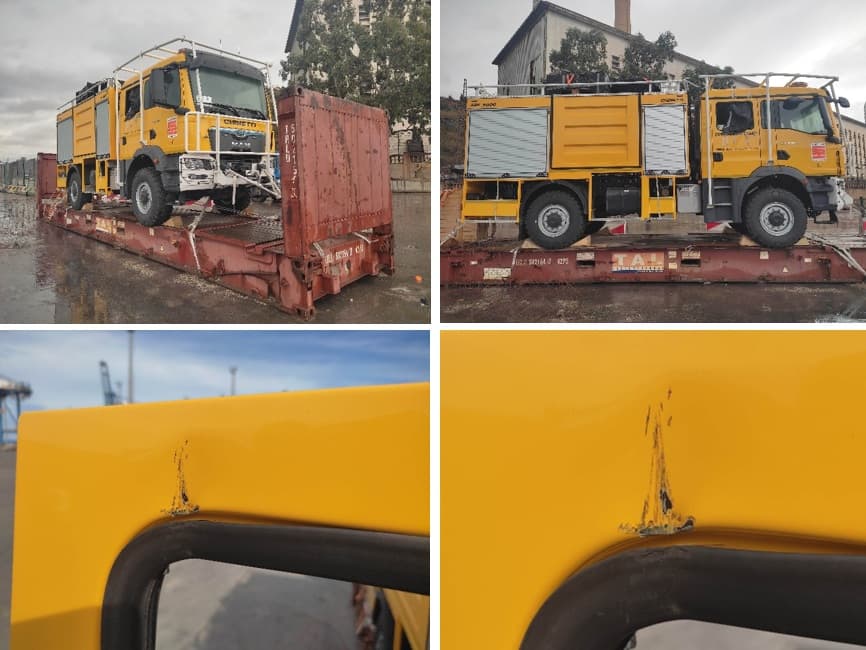
It doesn't arrive alone. It travels secured on a flat rack — that open steel platform exposed to the elements, designed to carry what won't fit inside a standard container. And this truck, indeed, is no ordinary vehicle: an 18-tonne yellow behemoth, 4x4, permanent all-wheel drive, 5,000-litre tank, built to intervene on petroleum and gas industrial sites where a single mistake can cost lives. A machine engineered for the most extreme conditions.
1. The Context
It had crossed the Mediterranean from Genoa. Upon arrival at the port of Oran, someone notices something on the rear right door. A broken window. Scratches. Bare metal. The insurer appoints an expert. The question seems straightforward: what happened, and how do you prove it?
2. The Crime Scene Has Thirty Minutes
The inspection lasts thirty minutes, under an overcast sky, in light rain. The approach is that of applied forensic engineering: starting from effects to work back to causes. Every step is documented, every observation is traceable, every conclusion must be falsifiable — meaning it can be challenged and verified by any other expert working from the same evidence.
The first phase is visual and tactile observation. The eye notes, the hand confirms. Deformations that light doesn't always reveal, touch detects. This dual sensory approach establishes a precise map of the damage: a permanent indentation of approximately 2mm in the sheet metal, two distinct impact points with exposed bare metal, a network of vertical scratches converging upward into a triangular pattern, a rubber sealing strip abraded over five centimetres. And inside the cab — tempered glass fragments, everywhere.
The second phase is systematic photographic documentation, conducted across progressive scales: wide shots to establish context, mid-range shots to orient, close-up shots to fix the evidence in place. Each photograph is an exhibit. Together, they constitute a dossier that can withstand scrutiny, including before a court.
3. When Physics Takes the Floor
This is where the expertise shifts from observation to reconstruction — and where the scientific disciplines take centre stage.
The first called upon is tribology — the science that studies the mechanisms of friction, wear, and lubrication between surfaces in relative contact. In tribology, a scratch is never trivial: it is the kinematic trace of a contact event, and its analysis allows precise reconstruction of the nature of the damaging agent, the direction and sense of movement, and the intensity of the applied force. The striations observed on the sheet metal exhibit a morphology characteristic of abrasive sliding: parallel grooves of decreasing depth, whose orientation indicates an upward displacement vector. In tribology, this progressive decrease in depth reflects a reduction in contact pressure during the sliding phase — the signature of an object moving away from its initial point of impact while maintaining diminishing residual contact. The contact surface itself, smooth and metallic in the exposed bare-metal zones, is consistent with a rigid sharp-edged agent, not a soft or textile contact.
Kinematics of solids then takes over to reconstruct the movement in space and time. The triangular pattern — wide base at the bottom, converging point at the top — constitutes an unambiguous directional indicator. During the initial impact, the rigid edge contacts the frame over an extended zone, generating a wide, deep imprint at the base. During the subsequent ascending phase, the contact geometry evolves: the interaction surface progressively narrows as the object rises, producing striations of decreasing width and depth that converge toward a superior point. This geometric reduction is mechanically consistent with the behaviour of a freely oscillating suspended load — a ballistic pendulum whose kinetic energy, maximum at the low point, dissipates progressively during the upswing. Kinematics thus excludes any fixed contact or lateral sliding, and points to a vertical oscillatory movement as the only compatible mechanism.
Strength of materials finally delivers the structural conclusion. The permanent indentation of the sheet metal testifies to a local exceedance of the elastic limit of the steel — the applied stress exceeded the threshold beyond which deformation becomes irreversible. This plastic deformation of the door frame induced a bending stress on the perimeter of the glazing, transmitting a progressively increasing peripheral constraint to the tempered glass. Tempered glass is a material of brittle elastic behaviour: it undergoes no prior plastic deformation and fractures instantaneously once the peripheral stress exceeds its resistance threshold — in the order of 120 to 200 MPa according to standard EN 12150. The complete fragmentation into multiple small non-cutting fragments is the characteristic behavioural signature of tempered glass under peripheral stress. The projection of the fragments toward the interior of the cab confirms that the stress originated from outside, transmitted through the frame, and not from a direct impact on the glass surface itself.
4. Eliminating, Until Only One Answer Remains
Forensic rigour does not stop at finding a plausible explanation — it requires confronting every hypothesis against the totality of observations and eliminating any alternative that generates a mechanical or factual inconsistency.
- A lashing chain running up along the flank? The white lateral protection bars, projecting from the sides of the vehicle, are perfectly intact. They would have been the first point of contact. Incompatible. Eliminated.
- A fixed element of the flat rack? The uprights are at the extremities of the platform, far from the damaged zone. No plausible mechanism. Eliminated.
- Spontaneous glass fracture through thermal shock or internal defect? Such a fracture generates neither plastic deformation of the sheet metal nor metallic deposits. Incompatible. Eliminated.
- A projectile or act of vandalism targeting the glass directly? The impact is located on the metal frame, not on the glazed surface. Incompatible. Eliminated.
Only one explanation simultaneously satisfies the totality of the observations without generating any inconsistency: a third-party load, suspended from a lifting device, set in oscillatory motion during port handling operations. Its edge struck the lower part of the door frame, then rose under the effect of its swing, transmitting maximum mechanical stress at its highest position — where the sealing strip is most abraded, where the glazing finally gave way.
5. The Conclusion
No one witnessed the incident. No camera, no handling report, no direct eyewitness. But tribology, kinematics, and strength of materials require no witness. They read within the material itself what no human eye observed.
The truck did not fail. No inherent defect in the cargo, no manufacturing flaw. This vehicle is built to withstand what few machines ever face. What damaged it was the port itself — the inevitable choreography of suspended loads, the swing of a piece of equipment handled too close, the centimetre of space too many or too few between two simultaneous operations.
The expert assessment establishes this with the certainty that only physical traces can confer: accidental damage, directly attributable to port handling conditions.