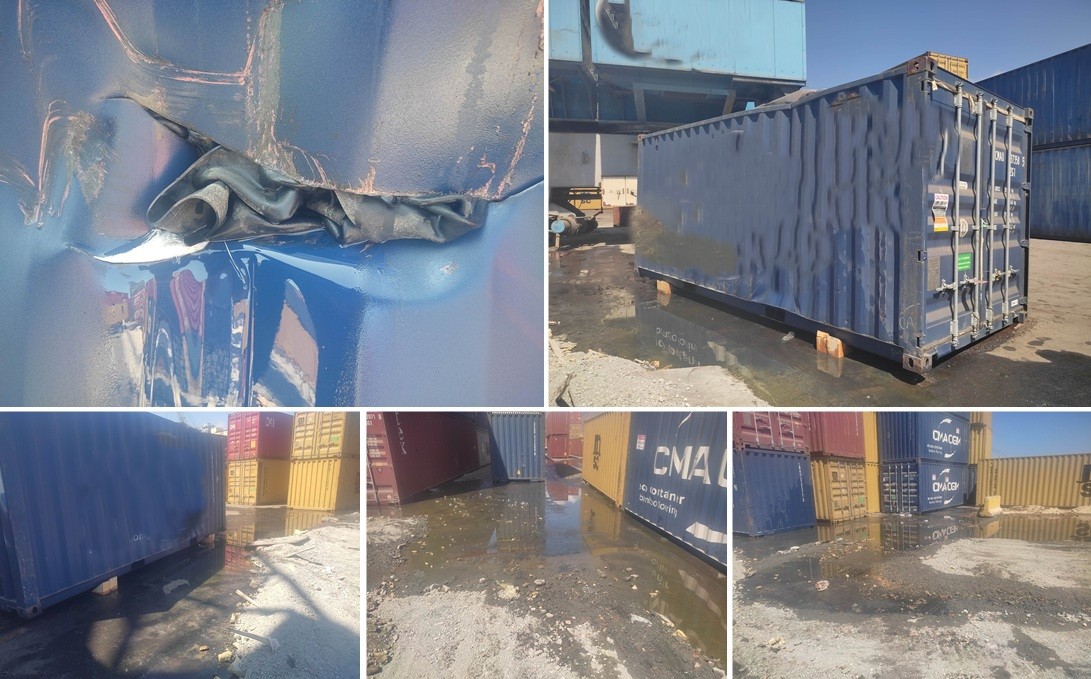
It sits alone at the edge of the port, listing visibly on uneven ground. From a distance, it looks like any other shipping container — battered, weathered, unremarkable. But something dark has seeped into the soil beneath it, spreading slowly into the surrounding earth. And on its left side wall, someone has hastily plugged a hole with expanding polyurethane foam, a white bulge protruding from the blue steel like a wound roughly dressed in the field.
1. The Context
Inside this container: nearly twenty tonnes of EHC 50, a high-grade paraffinic mineral base oil produced by ExxonMobil, transported in a flexitank — a single-use flexible bladder designed to convert a standard container into a sealed bulk liquid transport system. The cargo had left Valencia in good order. It had crossed the Mediterranean aboard its vessel. Somewhere between departure and arrival at the Port of Oran, something had gone very wrong.
The mission is clear but demanding: determine exactly what happened, how much was lost, and what the physics of the event can tell us that no witness account ever could.
2. The First Intervention: Reading a Scene
The initial inspection takes place on April 10th, in the presence of representatives of all parties concerned. The methodology is that of applied forensic engineering — systematic, layered, traceable. Every measurement, every observation, every photograph is a building block in a reconstruction that must hold up under technical scrutiny, and if necessary, before a court.
The visual and tactile examination begins with the breach itself. A roughly quadrilateral hole in the left side wall, measuring up to 35 cm in length and 15 cm in width, located 1.2 metres above the container floor. The upper edges bear concentrated metal scratches — not corrosion, not fatigue, but fresh mechanical marks consistent with a sharp, rigid contact. The steel shows no pre-existing weakness. This breach was not waiting to happen. It was made to happen, suddenly and violently, by an external force.
The container's geometry is measured. It leans at 15 degrees longitudinally and 5 degrees transversely. These are not trivial angles. They matter enormously — and the hydrostatic calculations will prove exactly how much.
Inside the container, the flexitank has been perforated. A clean, linear tear measuring 24 centimetres, with smooth edges and no fraying — the signature not of gradual tearing but of a sudden, concentrated cut. The tear runs parallel to the breach in the container wall, offset by just one centimetre, consistent with a slight displacement of the bladder at the moment of impact. The geometric correspondence between the two openings — same orientation, comparable length, millimetric alignment — tells the story of a single, direct, instantaneous event that punched clean through the container wall and into the liquid-filled membrane behind it.
3. The Physics of the Leak: Hydrostatics Takes the Stand
This is where the investigation moves from observation to calculation — and where a seemingly small detail, the container's tilt, transforms into a measurable amplifier of disaster.
Hydrostatics is the branch of fluid mechanics that governs the behaviour of liquids at rest under the influence of gravity. Its central principle is simple: the pressure exerted by a liquid column depends on the height of that column, the density of the fluid, and gravitational acceleration. In the formula P = ρ · g · h, every variable matters.
The oil's density is known precisely from the ExxonMobil certificate of analysis: 851.9 kg/m³ at 15°C. The breach height is measured at 1.2 metres above the container floor. But here is where the 15-degree longitudinal inclination becomes critical. When a container tilts forward with the breach on the descending side, the effective height of the oil column above the breach point is no longer simply 1.2 metres — it increases. Applying the geometric correction for the container's inclination over its 6-metre internal length, the effective head rises to approximately 1.46 metres. This represents a 22% increase in the height of liquid pressing against the breach.
The hydrostatic pressure at the breach therefore reaches 12.2 kPa — 22% higher than it would have been had the container been sitting level on flat ground. And since flow rate through an opening is proportional to the square root of pressure under turbulent flow conditions, or directly proportional under laminar flow conditions given the oil's relatively high viscosity, the inclination increased the rate of oil loss by somewhere between 10% and 22% compared to a flat scenario. A seemingly modest geometric detail — a container left tilted on uneven ground — translated directly into an additional 1.7% to 3.3% of cargo lost.
The numbers do not lie. Inclination was not a passive circumstance. It was an active contributor to the severity of the loss.
4. The Mechanics of Rupture: Structural Mechanics Quantifies the Blow
If hydrostatics explains the leak, structural mechanics explains the breach itself — and allows the expert to reverse-engineer the force of the impact from the physical evidence left in the steel.
The container wall is fabricated from Corten steel, a high-strength weathering alloy with an ultimate tensile strength of 355 MPa. The breach presents as an irregular trapezoid with a 6.5 cm indentation depth — the deformation distance over which the impact energy was absorbed. The impact angle, estimated at 30 degrees downward based on the breach geometry and scratch orientation, is consistent with the lower corner of a rigid trailer striking the container wall during a low-speed manoeuvring operation.
The structural mechanics analysis proceeds from first principles. The kinetic energy transmitted during impact is estimated from the effective mass directly involved in the collision — approximately 1,000 kg, representing the portion of the trailer that directly contributed to the initial shock, rather than the full vehicle mass — moving at an approach speed of roughly 10 km/h. The resulting impact force is calculated at approximately 59.5 kN.
Compared to the total structural resistance of the Corten steel sheet, this force reaches 33.4% of the panel's global yield strength — insufficient, at first glance, to cause catastrophic failure. But this global comparison masks the decisive factor: contact area. The trailer corner concentrated this force onto an estimated area of just 2 cm². The resulting localized pressure reaches 297.5 MPa — a figure that, under dynamic loading conditions and accounting for stress concentration at the corner geometry, effectively exceeds the steel's yield limit at the impact point. The metal exceeded its elastic limit instantly, underwent abrupt plastic deformation, and ruptured along an oblique axis matching the geometry of the impacting corner.
To put this in perspective for a non-technical reader: it is the mechanical equivalent of supporting the weight of two small cars on a surface no larger than a fingernail. The steel had no choice but to give way.
The flexitank behind it stood no chance. With a tensile strength of 11.1 kN and a tear resistance of 14.4 kN, the multilayer plastic membrane was subjected to a force exceeding its tensile strength by a factor of 22.4 and its tear resistance by a factor of 4.1. The perforation was instantaneous and complete.
5. Three Interventions, One Unbroken Chain of Evidence
The investigation does not stop at the breach. Over eight days, three separate interventions build an unbroken evidential chain from the physical event to its financial consequences.
The second intervention, conducted across two days at a transfer depot, involves the complete extraction of the residual oil from the damaged flexitank into nineteen intermediate bulk containers, each carefully weighed. The initial weighing yields a net recovered quantity of 17,580 kg gross. Deducting the tare weight of nineteen empty IBCs at 65 kg each, the net recovered product is established at 16,345 kg.
The third intervention takes the evidence to a certified industrial laboratory for independent verification. The IBCs are reweighed: 17,580 kg confirmed. Five samples are collected for qualitative analysis. All five pass. The oil meets its original specifications entirely — no contamination, no degradation attributable to the accidental exposure. The cargo that survived the breach remained commercially usable.
The arithmetic is then precise and final. The bill of lading declared 19,980 kg net. The recovered product totals 16,345 kg. The loss is 3,635 kg — exactly 18.2% of the initial cargo. At the invoiced unit price, the financial impact of this single localized mechanical event amounts to USD 4,176.62.
6. The Conclusion
No witness saw the collision. No camera captured the moment the trailer corner struck the container wall. But the science did not need a witness.
Structural mechanics calculated the force from the geometry of the breach and the properties of Corten steel. Hydrostatics calculated the aggravating effect of an 8-degree inclination from the oil's density and the container's measured tilt. Materials science established the rupture threshold of the multilayer flexitank from its ASTM-certified tensile and tear resistance parameters. Metrological verification — double weighing at two independent sites — quantified the loss to the kilogram.
The root cause is established beyond reasonable technical doubt: a rigid trailer component, most likely a lower corner fitting, struck the container wall during a low-speed manoeuvre within the port. The geometric concentration of a moderate kinetic force onto a 2 cm² contact area generated a localized pressure sufficient to breach Corten steel and instantaneously perforate the flexitank membrane behind it. The container's subsequent positioning on uneven ground amplified the rate of leakage by up to 22%.
No manufacturing defect. No installation fault. No inherent weakness in the cargo or its containment system. A single, brief, violent mechanical event. And the science to prove every step of what it caused.