A multipurpose cargo vessel berths at an Algerian port at the end of the year, having crossed the Mediterranean from a Russian loading port. On board: over 7,700 metric tons of monoammonium phosphate in bulk — a highly hygroscopic granular fertilizer, distributed across three holds. From the moment the vessel arrives, the Master raises a major concern: a possible ingress of seawater into hold No. 2 during the voyage.
1. The Context
The cargo belongs to a Russian shipper, consigned to the order of an Algerian bank for the benefit of a local receiver. The shipowner is covered by a leading international P&I Club, which mandates a local claims agency to appoint an independent surveyor. The Master files a Sea Protest even before discharge commences — a standard protective measure, but one that speaks volumes about the anxiety on board. The stakes are considerable: MAP 12-52 is a water‑soluble cargo, highly sensitive to moisture, whose agronomic and commercial value can be irreversibly compromised by contact with seawater.
2. The Heart of the Problem
On the surface, the situation appeared straightforward: a storm, a heavily loaded vessel with reduced freeboard, and a potentially damaged cargo. But the underlying legal and technical questions were far more complex.
- Two months before the voyage, the vessel had undergone an ultrasonic test (UST) of its hatch cover weathertightness, conducted by a recognized independent body. The official conclusion: "satisfactory." How, then, to explain seawater infiltration if the hatch covers had been deemed compliant?
- During the initial inspection at hatch opening on December 31st, no visible traces of infiltration were detectable on the surface of the cargo. Everything appeared sound. Were we facing a real casualty — or a false alarm?
- The receiver and their surveyor were claiming total damage on a portion of the cargo, without the actual affected quantity having yet been established. The shipowner, meanwhile, had every interest in minimizing his liability by invoking the exceptional weather conditions as the sole and exclusive cause.
3. The Investigation
A Two-Stage Inspection: Patience as Method
The first inspection, conducted on the very day discharge began, revealed no obvious signs of damage on the surface. A less rigorous surveyor might have concluded that no casualty had occurred. I chose instead to maintain active monitoring and suspend any definitive judgment. It was on the fourth day of operations that the truth began to emerge — literally. As the upper layers of cargo were progressively removed, the lower sections of the hold revealed what the surface had been concealing: grey, caked cargo exhibiting all the classic signs of a chemical reaction with seawater. Solidified blocks, residual yellowish liquid at the bottom of the hold — the timeline of the infiltration was taking shape.
Reading the UST Results: Between Letter and Spirit
The ultrasonic test report deserved a close and critical reading. On the face of it, the results appeared favorable — the tester had concluded with an overall "satisfactory" verdict. But when the raw data was analyzed measurement by measurement, a very different picture emerged.
- For hold No. 1: two defective point values (DPV) recorded at respectively 1.97 times and 2.5 times the acceptable leakage threshold.
- For hold No. 2: two points at 1.95 times and 3.5 times that same threshold.
In other words, the worst leak point in hold No. 2 exceeded the critical threshold by 250%. These anomalies were documented in the report itself — they had simply not been properly interpreted, or their dynamic significance had been overlooked. The fundamental distinction is this: a UST is conducted at berth, under static conditions. It provides a snapshot of weathertightness at rest. But a vessel at sea — particularly in Beaufort 7 to 8 winds and waves of 3 to 4 meters — is subjected to forces of an entirely different magnitude: flexing of the hatch panels under hydrodynamic pressure, repeated immersion cycles caused by a freeboard reduced to approximately 1.80 meters in loaded condition, pitching and rolling motions reaching up to 20°. These dynamic forces transform marginal weaknesses into actual pathways for water ingress.
The Weather as Evidence
The vessel's logbook constituted a valuable source of information. Over a ten-day period, from December 19th to 29th, the recorded meteorological data showed winds ranging from force 6 to 8 Beaufort, wave heights of 3 to 4 meters, and low barometric pressures characteristic of successive depression systems. Each logbook entry noted water shipped on deck, and significant pitching and rolling throughout. This was not a single, exceptional storm — it was a hostile and persistent sea state that subjected the hatch covers to continuous and cumulative stress over ten days.
Chemistry as a Silent Witness
The yellowish liquid observed at the bottom of the hold — visible in photographs taken the day before the completion of discharge — was far from incidental. This characteristic coloration is the unmistakable signature of a well‑documented chemical reaction: the partial dissolution of MAP by seawater releases phosphate ions, which react with iron ions from the corrosion of the metal hold walls to form ferric phosphate — FePO₄ — an insoluble compound ranging in color from yellow to brownish-orange. This reaction unambiguously confirms the simultaneous presence of infiltrated seawater and dissolved MAP within the hold, and demonstrates that the infiltration did not occur recently but during the voyage, over a sufficient duration to generate these precipitates.
Physical Inspection of the Hatch Covers: Tangible Proof
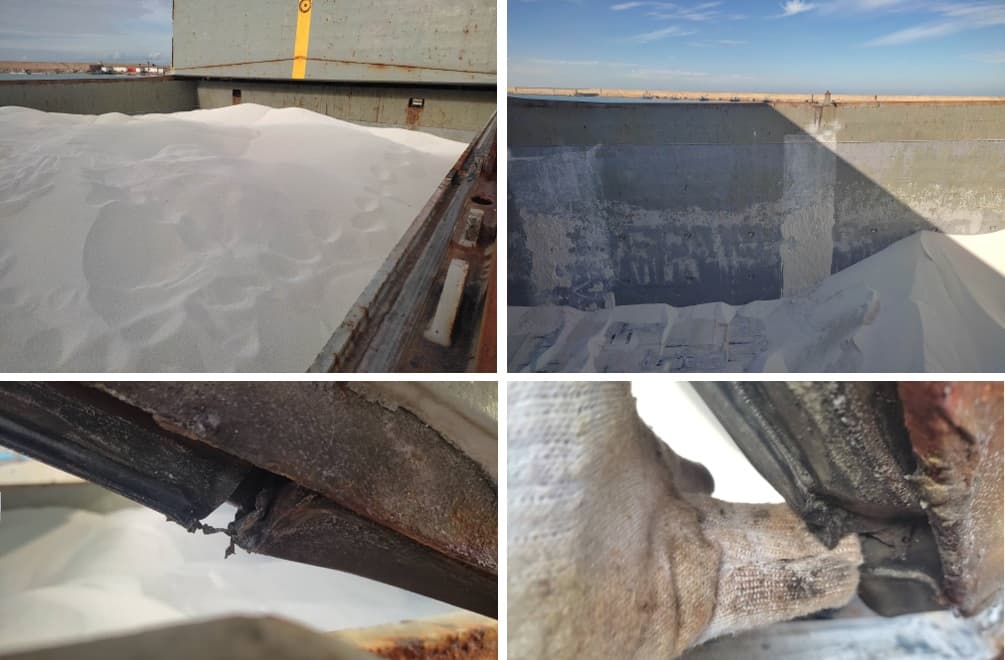
The detailed visual examination of the hatch covers of hold No. 2 identified two critical infiltration zones, documented photographically and plotted on annotated diagrams.
- The first zone concerned the longitudinal inter‑panel joint, at the junction between the two folding hatch panels. Misalignment and insufficient compression of the sealing gasket had created a gap allowing water passage. The presence of uncured black resin on the hatch coaming was evidence of prior incomplete or improperly executed repairs.
- The second zone affected the compression bar line along the rubber packing, on both the port and starboard sides, fore and aft. The rubber gaskets exhibited localized discontinuities — gaps in the sealing strip that, under dynamic pressure, became pathways for water ingress.
4. The Conclusion
What Was Established
The investigation established that the cargo damage resulted from the combination of two contributing factors: on one hand, pre‑existing and documented deficiencies in the hatch cover sealing system — evidenced by UST values that significantly exceeded acceptable thresholds — deficiencies that existed prior to departure and had not been rectified. On the other hand, severe and sustained weather conditions that subjected these weaknesses to dynamic stresses far exceeding the static conditions of the test — transforming points of vulnerability into actual infiltration pathways. The shipowner's liability was therefore engaged not on grounds of a "meteorological force majeure," but precisely because the vessel was not in a fit state to withstand conditions that, while severe, were by no means abnormal for a winter passage in the Mediterranean.
Impact and Outcome
The receiver had initially estimated the damage at 36 metric tons of affected cargo. The final tally established by draft survey indicated a total discharged cargo of 7,745.5 metric tons — an excess of 45.5 metric tons over the bill of lading figure — with a declared damage of 36 metric tons. No overall weight shortage was recorded, confirming that the damage was qualitative in nature (chemical alteration) rather than quantitative (loss of mass). In terms of recommendations, the report called for the full replacement of the defective rubber gaskets, adjustment of the compression mechanisms, treatment of corroded areas within the holds with application of an epoxy anti‑corrosion coating, and the implementation of a systematic inspection and cleaning protocol for hatch cover drains before each voyage.