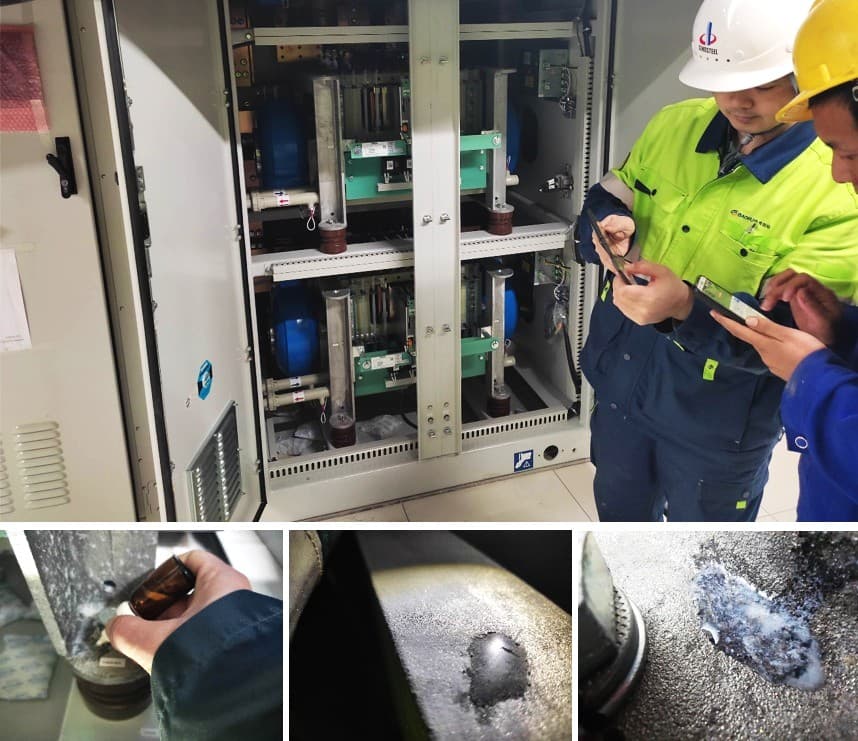
When the five cabinets arrive at their destination, something is wrong. The reception technicians who open the doors of the high-voltage variable frequency drives — among the most sophisticated industrial equipment on the market, designed to control high-power motors with surgical precision — find something unexpected. The internal chassis, which should display a clean, uniform metallic gray, are covered in a whitish, powdery substance, like dirty snow settled across every beam, every crossmember, every recess of the galvanized structure.
1. The Arrival of a Doubt
This is not simple storage dust. It is something else. And no one yet knows what. The question put to the expert is straightforward, almost binary: have these machines been in contact with seawater? Yes or no. The answer, however, would demand far more than a cursory glance.
2. What Corrosion Has to Say
Before reaching for a single chemical reagent, the visual inspection already speaks volumes — to those who know how to read the language of corrosion. Galvanized steel works on an elegant principle: the zinc coating sacrifices itself in place of the iron beneath. It oxidizes first, forming a stable patina — an invisible yet tenacious shield — that protects the whole structure for decades. Under normal conditions, even aggressive ones, this degradation is slow, uniform, and predictable.
What is observed here is anything but normal. The white deposits cover 85 to 95% of the internal surfaces across all five units. They are not scattered at random: they concentrate in tight recesses, beneath screw heads, within interstices — those dead zones where liquid naturally migrates by capillary action before evaporating slowly, leaving its salt residues trapped behind. The texture is chalky, friable. In certain areas, the zinc coating has blistered, as if something had attacked from within with speed and brutality.
This is not aging. This is not industrial humidity. This is a large-scale chemical assault. And the distribution pattern — liquid that penetrates, evaporates, and deposits its salts in the most enclosed areas — is a signature the expert recognizes immediately. But a visual signature alone is not enough to settle a dispute. Chemical proof is required.
3. The Chemical Investigation: The Silver Nitrate Test
Silver nitrate is a reagent of remarkable specificity: in contact with chloride ions — such as those found in seawater — it instantly precipitates into silver chloride, a milky-white compound. Subsequently exposed to ambient light, this precipitate reduces to metallic silver and progressively darkens. It is precisely the same chemical principle underlying silver-based photography.
But this test, as powerful as it is, is treacherous for those who do not master it: the white rust of zinc — visually similar to the silver chloride precipitate — can mislead an untrained eye. Successive condensation events may also dilute surface chloride concentrations below immediate detection thresholds, even as they remain dangerously active at depth. The challenge is not merely applying the reagent — it is knowing where to apply it.
The expert targets strategic retention zones: interstices inaccessible without partial disassembly, thermally dead zones where salts accumulate undisturbed, and structural folds where salt-laden water would naturally have migrated by capillary action before slowly evaporating.
First, a negative control: the reagent is applied to a clean, uncontaminated bolt from the same equipment batch. No reaction. The reagent produces no false positives on a healthy galvanized surface. The protocol is validated. Then comes the test on the corroded zones.
4. Three Colors, One Truth
The reaction is immediate and striking. Within seconds, a milky-white precipitate appears, spreading by capillary action along the microfissures of the corrosion layer — revealing that chloride ions do not merely sit on the surface, but have penetrated deep into the very fabric of the degraded zinc.
Minutes later, exposed to ambient light, the precipitate begins to darken. Dark micro-crystals emerge, marking the photochemical reduction of silver chloride to metallic silver. This is the definitive confirmation: only halides produce this reaction. Sulfates, carbonates, nitrates — all other possible industrial contaminants — do not generate this signature.
But there is more. On certain zones, a third color appears: brown and orange spots, characteristic of silver bromide. Bromide is a specific marker of seawater — fresh water does not contain it in significant quantities. The simultaneous presence of white, brown, and black precipitates at the same test site no longer simply says chlorides are present — it says this is raw seawater, a complex electrolyte, not a single-source industrial contamination.
The tests are repeated methodically across all five units — in visibly corroded zones, in transition zones, and in apparently intact areas accessible only after partial disassembly. The result: 100% correlation between the presence of white deposits and a positive chloride reaction. And in certain visually intact zones, subsurface chloride traces are detected — the contamination has penetrated deeper than the eye can see.
5. Eliminating the Impossible
Sound forensic expertise does not stop at finding an explanation — it must eliminate every other.
- Industrial atmospheric corrosion? It produces a uniform, diffuse patina, not blistered deposits concentrated in enclosed zones. Excluded.
- Road de-icing salts? Incompatible with equipment handled in closed, controlled conditions. Excluded.
- Acid-based cleaning agents? They would have attacked accessible surfaces uniformly, not recesses inaccessible without disassembly. Excluded.
- Marine atmosphere — the coastal salt spray of seaside environments? It produces thin, uniform surface corrosion. Not thick, blistered deposits inside crevices. Excluded.
- Simple condensation of pure water? It introduces no chlorides. And without chlorides, no white rust. Excluded.
Only one explanation remains consistent with the totality of observations: direct contact with seawater or salt-laden marine moisture, followed by slow evaporation leaving salts trapped within capillary retention zones.
6. The Answer
The question was simple. So is the answer. Yes — this equipment was exposed to seawater. Most likely during maritime transport. The sea had entered the cabinets, worked its way into every interstice, evaporated — and left behind its chemical imprint. An imprint that the materials themselves had preserved, intact, waiting to be read by those who knew the right questions to ask, and where to ask them.
These high-voltage drives, engineered for dry, controlled environments, now carried within them a contamination invisible to the naked eye yet chemically active. Hygroscopic chloride ions continue to absorb ambient moisture. They migrate into connectors, beneath circuit boards, along conductors. They wait only for the first voltage to be applied before triggering electrochemical short circuits.
The sea had left its mark. The expertise had known how to read it.
Expert Report — Anonymised Version
Read the full investigation report: methodology, chemical tests, findings, and conclusions. All confidential data has been redacted in accordance with professional ethics.