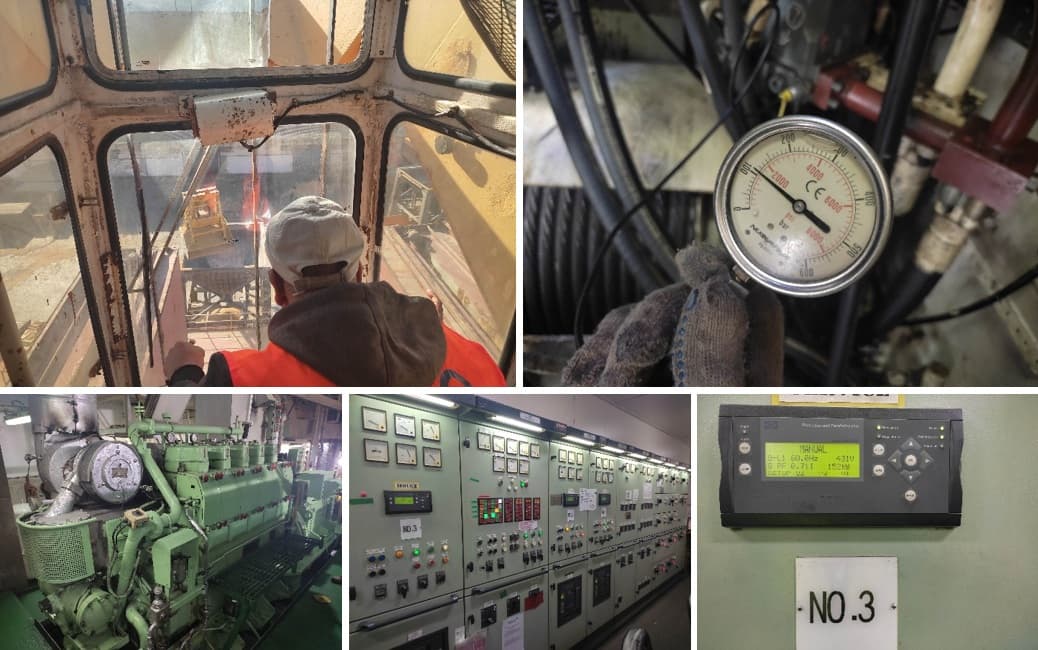
A bulk carrier at berth in an Algerian port. On board: over 40,000 tonnes of soybeans in bulk, loaded in the United States, awaited by a local cargo receiver. Discharge operations begin, but something is quickly off. The cranes are working — but working in slow motion. Not one crane, not two: every single crane on the vessel.
1. The Context
The cargo receiver files a formal complaint. He reports significant delays attributable to the systemic slowness of the lifting equipment, and requests an independent investigation. It is in this context that I am appointed by the vessel's time-charterers to conduct a thorough technical inquiry.
2. The Core Problem
At first glance, the hypotheses are multiple: a hydraulic issue? An electrical fault? Localised mechanical wear? The difficulty lies in the fact that the slowness is generalised across all equipment — which immediately rules out a purely localised or accidental cause. This is not one defective crane, but an entire system operating below capacity.
To establish incontestable facts, the slowness must first be quantified, then its origin identified. The investigation unfolds across three successive interventions.
3. The Investigation
First Intervention: Observe and Measure
Before any hypothesis, the raw facts. During the initial joint inspection — bringing together the shipowner's surveyor, the receiver's surveyor, and my own observations — I time the operational cycles of each active crane.
The equipment consists of electro-hydraulic ship cranes with a nominal lifting capacity of 30 tonnes, whose theoretical slewing speed per the manufacturer's specifications is 0.6 rpm. Under real operating conditions, the observed cycles allow an effective slewing speed to be calculated. The method applied is rigorous: in bulk discharge operations, the crane performs a 90° swing toward the quay, then a 90° return to the hold — totalling 180° per complete cycle. This operational reality, rather than a theoretical 360° rotation, forms the basis for calculation.
The results are unambiguous:
- Crane No. 1: effective speed 0.125 rpm — 4.8 times slower
- Crane No. 3: effective speed 0.105 rpm — 5.7 times slower
- Crane No. 4: effective speed 0.107 rpm — 5.6 times slower
Second Intervention: The Hydraulic Hypothesis
The first natural lead is hydraulic. The vessel had recently undergone replacement of hydraulic hoses at a previous port call. An incomplete circuit purge could explain insufficient fluid flow, and therefore a loss of performance.
I carry out pressure measurements on the hydraulic pumps of each crane, both under load (9 tonnes) and without load. The pressures recorded are within specification for all tested cranes. The hydraulic system is capable of generating the required force. However, two important limitations temper this conclusion:
- Pressure does not guarantee flow. A circuit can hold pressure while still carrying insufficient flow, particularly if residual air is present.
- A flow test could not be performed, as the vessel's operational constraints (discharge in progress) made it impossible without prolonged shutdown of the hydraulic circuit.
- The system maintenance plan was unavailable, making it impossible to verify the intervention history on the hydraulic circuits.
The hydraulic hypothesis is therefore partially set aside, but not definitively closed. It may contribute marginally to the problem. The primary cause lies elsewhere.
Third Intervention: The Electrical Investigation
If the problem is not primarily hydraulic, the investigation must trace back to the power source. I head down to the engine room.
Inspection of the Alternators
The vessel is fitted with three synchronous alternators. During the intervention, two are running in parallel, the third on standby. I record all operating parameters: high and low temperature cooling water pressures, charge air pressure, fuel oil pressure, and lubrication oil pressure. All parameters are within normal ranges. The alternators are running at their nominal speed (720 rpm), and the network frequency is stable at 60 Hz. One point of attention is noted for the turbocharger of one alternator, whose pre-turbo oil pressure is slightly lower — an early sign of wear to monitor, but insufficient to explain the crane slowness.
Data Collection at the Engine Control Room
I then proceed to the engine control room to analyse the electrical parameters during lifting operations. The investigation unfolds in two phases: first with a single crane operating, then with two cranes running simultaneously.
Results:
- Measured voltage: 431 V (nominal: 450 V) — slightly low, but stable and without significant operational impact.
- Frequency: perfectly stable at 60 Hz.
- Current drawn by a loaded crane (9 tonnes): maximum 180 amperes.
This is where the critical anomaly lies.
The Discrepancy That Reveals Everything
Upon inspecting the crane electric motors, I discover a fundamental discrepancy between the documentation provided by the shipowner and the actual equipment on board. According to the technical sheets supplied, the crane motors should be 127 kW motors in continuous mode (S1) and 203 kW in intermittent mode (S6), with a nominal current draw of approximately 270 amperes. The motors actually installed are 380 kW units, with a nominal full-load current of 731 amperes.
At 60% capacity — the configuration observed, with a 9-tonne empty grab plus 9 tonnes of cargo, totalling 18 tonnes against a 30-tonne rated capacity — the expected theoretical consumption is approximately 440 amperes. Yet the equipment draws only 180 amperes.
The probable cause: either a poorly configured or defective Variable Frequency Drive (VFD), or internal degradation of the motor windings after 14 years of service without any documented preventive maintenance.
The Missing Maintenance Plan: A Finding in Itself
Throughout the investigation, I requested access to the System Maintenance Plan (MSP) — for both the hydraulic and electrical systems. The document was never made available. Two interpretations are possible, and neither is reassuring: either the document does not exist (a non-compliance with ISM Code requirements), or it was deliberately withheld — suggesting a problematic maintenance history the shipowner preferred not to expose.
4. The Conclusion
At the close of this three-phase investigation, the conclusions are established with a solidity that the data fully supports:
The systemic slowness of the cranes is not caused by the alternators (which are functioning correctly), nor primarily by the hydraulic system (functional within measurable limits), but by a limitation in the current drawn by the electric motors — most likely caused by a defective or misconfigured Variable Frequency Drive, compounded by the natural degradation of motors now 14 years old with no documented preventive maintenance on record.
The recommendations set out in the report address three areas: inspection and reconfiguration of the Variable Frequency Drives, implementation of a documented maintenance plan compliant with ISM standards, and motor replacement in the event of irreversible degradation.
For the time-charterers, this expert report delivers a documented, objective, and opposable answer: the operational slowness is real, measured, and quantified; it is attributable to the vessel's condition rather than to operating practices; and it substantiates the claims brought forward by the cargo receiver.